TonicNest may earn a commission if you buy through links on this page, at no extra cost to you. That does not change what we report.
Part of our Joint Glide overview. Last checked October 27, 2026.
Joint Glide side effects reported in research on its ingredients are mostly mild stomach upset, but the white willow bark is an aspirin relative, so the bigger risks involve aspirin allergy, blood thinners and NSAIDs. In a safety analysis of 28 devil's claw trials, about 3% of users had minor side effects, mostly digestive[4].
The FDA adverse event database (CAERS) held no reports naming Joint Glide when we searched on October 27, 2026[14]. No study of the product itself exists, so its own side effect rate is unknown.
Is Joint Glide safe? Safety at a glance
For most healthy adults the label doses are modest, but Joint Glide is not a fit for everyone. The biggest caution is the white willow bark extract: it contains salicin, which the body turns into salicylic acid, the same family as aspirin. The USP safety monograph says willow bark is not for children, pregnant or nursing women, or people with known aspirin sensitivity[2].
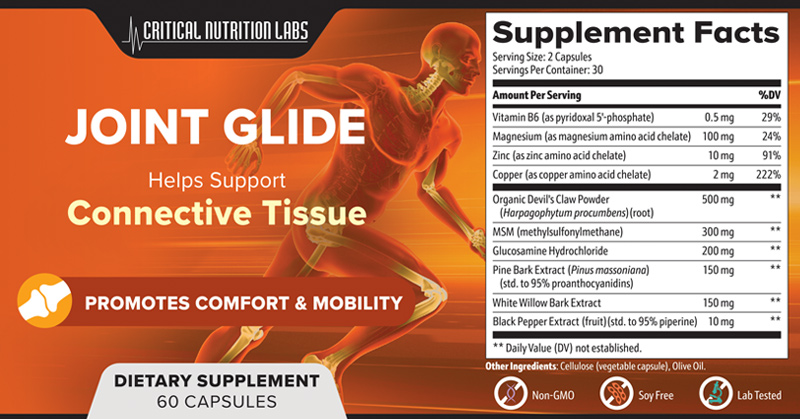
Three more ingredients add cautions. Devil's claw has case reports of stomach bleeding and ulcers[5]. Glucosamine has been tied to a higher bleeding risk in people on warfarin[6]. Black pepper extract (piperine) can raise blood levels of some prescription drugs[9]. The label does not state the salicin content or the glucosamine source[1], so you cannot work out your exact exposure from the bottle.
What side effects are possible?
The side effects reported in ingredient studies fall into three groups: digestive upset, allergic or sensitivity reactions, and problems that come from mixing with medicines.
Digestive
Stomach upset is the most common complaint for both devil's claw and willow bark[2][4]. In double-blind devil's claw trials, it was never more frequent than on placebo. Separate case reports describe stomach bleeding and ulcers, and the French journal Prescrire said devil's claw is "best avoided"[5].
Allergy and sensitivity
People sensitive to salicylates are the main concern with willow bark, and one severe allergic reaction occurred in a 210-person willow bark trial[3]. Glucosamine is often made from shellfish shells. Australian reports from 2000 to 2011 counted 263 hypersensitivity reactions among 366 glucosamine adverse reactions[8].
Medication-related
Bleeding risk can rise when salicylates or glucosamine meet blood thinners[2][7]. Glucosamine may also raise blood sugar in some people[6].
Which Joint Glide ingredients deserve extra attention?
Four ingredients carry most of the safety load: white willow bark, devil's claw, glucosamine and black pepper extract. The table sets out the issue for each, using only what our sources say, with the label amount from the vendor's Supplement Facts panel[1].
| Ingredient (amount) | Safety issue | Why it matters |
|---|---|---|
| White willow bark extract (150 mg) | Salicylates; aspirin allergy, under 18, pregnancy | 240 mg salicin can yield about 113 mg salicylic acid, against 62 mg from an 81 mg aspirin[2]; Joint Glide's salicin is not stated |
| Devil's claw root powder (500 mg) | Stomach bleeding and ulcer case reports | A history of stomach or duodenal ulcers or bleeding is a reason to avoid it[5]; no long-term safety data[4] |
| Glucosamine HCl (200 mg) | Warfarin, shellfish source, blood sugar | Raised INR in case reports[7]; source not on the label |
| Black pepper extract (10 mg piperine) | Changes drug absorption | Raised carbamazepine exposure (AUC) by 47.9% in a study[10] |
| Pine bark, Pinus massoniana (150 mg) | Little safety data for this species | No serious adverse effects reported, but toxicology data are limited[12] |
| Copper (2 mg, 222% DV) | Stacking with other supplements | NIH upper limit is 10 mg a day; people with Wilson disease should avoid extra copper[13] |
| MSM (300 mg) | Low concern at this dose | Well tolerated up to 4 g a day in most people[11] |
Which medicines could interact with Joint Glide?
Show the Joint Glide label to a pharmacist if you take any of these medicine groups. The list comes from the ingredient sources above, and some items are precautions rather than proven interactions.
- Blood thinners such as warfarin: glucosamine raised INR in case reports[7], USP names anticoagulant users as a vulnerable group for willow bark[2], and devil's claw is a precaution here too.
- Aspirin, other salicylates and NSAIDs such as ibuprofen, naproxen or diclofenac: willow bark adds to salicylate exposure[2], and devil's claw is linked to stomach bleeding reports[5].
- Diabetes medicines: glucosamine may raise blood sugar[6]. Herbal references also list diabetes medicines as a reason to ask before taking devil's claw; the studies we read did not test this.
- Narrow-window drugs such as carbamazepine, phenytoin, theophylline, propranolol and immunosuppressants: piperine changed how the body absorbed several of these[9][10].
Lab work suggests devil's claw extracts only weakly affect the liver enzyme CYP3A4[15], so piperine is the bigger absorption concern. Our guide to taking Joint Glide covers timing around other pills.
Pregnancy, breastfeeding and who should ask a doctor first
Some people should skip Joint Glide or get a doctor's go-ahead before the first capsule:
- Pregnant or breastfeeding women: USP labels willow bark not for use, and glucosamine safety is unknown[2][6].
- Anyone under 18, because of salicylates and Reye syndrome[2].
- People with an aspirin or salicylate allergy.
- People with a shellfish allergy, until the seller confirms the glucosamine source.
- Anyone with a stomach or duodenal ulcer or past stomach bleeding[5].
- People with gallstones (a devil's claw caution in herbal references, not tested in our sources).
- People with kidney disease (a general salicylate precaution).
- People with diabetes, on blood thinners or on regular prescriptions.
- People with Wilson disease, because of the added copper[13].
Which symptoms need a doctor right away?
Stop Joint Glide and get medical help right away if you notice any of these. Some point to a reaction, and some point to a joint problem that a supplement should not mask.
- Swelling of the face, lips or tongue, hives or trouble breathing.
- Black or bloody stools, vomiting blood, or stomach pain that does not ease.
- Unusual bruising or bleeding, especially if you take a blood thinner.
- A hot, red, swollen joint, or joint pain with a fever.
- Joint pain after a fall or injury.
- Joint pain that wakes you at night.
Joint Glide safety conclusion
Joint Glide is likely to be tolerated by healthy adults who take no regular medicines, but its willow bark, devil's claw, glucosamine and piperine each raise questions for people on blood thinners, NSAIDs, diabetes medicines or narrow-window drugs. The unstated salicin content and glucosamine source mean you cannot judge your exposure from the label alone. If you fall into any group above, ask your doctor or pharmacist first. Our Joint Glide ingredients breakdown shows each dose, and how we check products explains our method.
Back to the Joint Glide overview.
Frequently asked questions
Can Joint Glide upset your stomach?
It can. Digestive upset is the most common side effect reported for devil's claw and white willow bark, two of its main ingredients. Taking the 2 capsules with a few bites of food, as the vendor directs, is sensible. Stop and see a doctor if you notice black stools.
Can I take Joint Glide with ibuprofen or aspirin?
Ask your doctor first. White willow bark contains salicin, an aspirin relative, and USP notes added risk with other salicylate medicines. Devil's claw has stomach bleeding case reports, so combining it with NSAIDs such as ibuprofen or naproxen needs medical advice.
Is Joint Glide safe with a shellfish allergy?
The label does not state the glucosamine source, and glucosamine is often made from shellfish shells. Ask the seller, Critical Nutrition Labs, at 1-727-351-3065 to confirm the source, and check with your allergist before taking it.
Can I take Joint Glide with warfarin?
Not without your doctor. NCCIH says glucosamine is associated with a higher bleeding risk in people taking warfarin, and willow bark adds salicylates. Your doctor may want to check your INR more often or advise against it.
Are there FDA adverse event reports for Joint Glide?
When we searched the FDA CAERS database on October 27, 2026, no reports named Joint Glide, and openFDA showed no recalls. That does not prove safety, because the database only holds reports that people or companies choose to file.
Sources
- Joint Glide Supplement Facts label image. Critical Nutrition Labs (getjointglide.com), read October 27, 2026.
- USP safety evaluation of willow bark. PubMed, read October 27, 2026.
- Willow bark extract for low back pain flares, randomized trial (Chrubasik 2000). PubMed, read October 27, 2026.
- Safety of devil's claw, analysis of 28 trials (Vlachojannis 2008). PubMed, read October 27, 2026.
- Devil's claw: gastrointestinal bleeding and ulcer case reports (Prescrire 2013). PubMed, read October 27, 2026.
- Glucosamine and Chondroitin for Osteoarthritis: What You Need To Know. NCCIH, archived copy, read October 27, 2026.
- Glucosamine and warfarin: raised INR reports (Knudsen 2008). PubMed, read October 27, 2026.
- Glucosamine adverse reaction reports in Australia, 2000 to 2011. PubMed, read October 27, 2026.
- Piperine and the absorption of propranolol and theophylline. PubMed, read October 27, 2026.
- Piperine and carbamazepine pharmacokinetics. PubMed, read October 27, 2026.
- Methylsulfonylmethane: applications and safety (Butawan 2017). PubMed, read October 27, 2026.
- Pine bark extracts across species: research and safety data. PubMed, read October 27, 2026.
- Copper fact sheet for health professionals. NIH Office of Dietary Supplements, read October 27, 2026.
- openFDA CAERS adverse event search for Joint Glide. US FDA, read October 27, 2026.
- Devil's claw extracts and CYP450 enzymes in vitro. PubMed, read October 27, 2026.
This page is general information, not medical advice. Dietary supplements are not reviewed by the FDA for safety or effectiveness before they are sold and are not intended to diagnose, treat, cure or prevent any disease. Talk to your doctor before taking any supplement, especially if you are pregnant, nursing, take medication or have a health condition.