TonicNest may earn a commission if you buy through links on this page, at no extra cost to you. That does not change what we report.
Part of our Joint Glide overview. Last checked October 27, 2026.
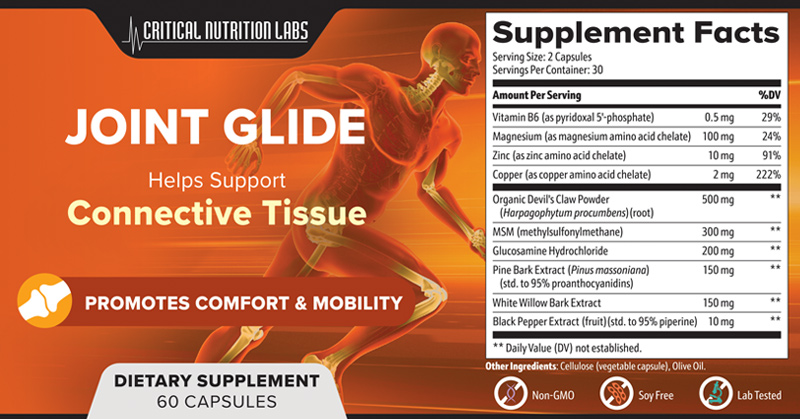
Does Joint Glide work? Nobody can say yet, because no study has tested the finished product. Its ingredients have small and mixed results in osteoarthritis trials, usually at much higher doses. Glucosamine is the clearest case: the NIH-funded GAIT trial gave 1,500 mg a day to knee patients and found no pain benefit over placebo[3]. Joint Glide has 200 mg.
Does Joint Glide work? The short answer
Joint Glide may give mild joint pain relief to some people, but there is no direct proof either way. What we can conclude: the label is fully disclosed[2], three ingredients (devil's claw, MSM, white willow bark) have at least one trial with some benefit for osteoarthritis pain or function, and every one of those trials used more than Joint Glide supplies.
What we cannot conclude: that the product rebuilds cartilage, works within 3 to 7 days, or helps anyone avoid surgery. The sales letter says all three[1]. Those are vendor claims, and no published study of Joint Glide supports them.
The pine bark adds nothing measurable here. The label says Pinus massoniana, which has no human joint research.
Which evidence levels should you not confuse?
Four levels of evidence get mixed up in supplement marketing. Only the last two can show that a product works, and Joint Glide has neither.
Plausibility
A lab or animal finding, or a story such as the vendor's "rust enzyme", suggests a way something might work. It shows nothing about people taking 2 capsules a day.
Ingredient trials
Trials of one ingredient at a set dose. These exist for devil's claw, MSM, glucosamine and willow bark. They tell you what that dose did in that group, not what a 10-ingredient capsule at lower doses will do.
Finished-product trial
A placebo-controlled trial of Joint Glide itself. We found none.
Replication
A second independent trial with the same result. Even at the ingredient level this is thin: willow bark helped in one osteoarthritis trial[8] and failed in another[9], and a review of devil's claw trials called their methods generally poor[6].
Joint Glide claims vs what the evidence supports
The vendor's main claims go well past what ingredient research can support. This table sets each one against a reasonable reading.
| Vendor claim | Reasonable reading | Limitation |
|---|---|---|
| "Rebuild Thick Strong Cartilage In Days" | No ingredient trial we read measured cartilage regrowth in days | No product trial; trials scored pain over weeks |
| "Avoid Surgery" | Not supported by any study we found | Surgery decisions need a diagnosis and a doctor |
| Relief "within 3-7 days" | Ingredient trials ran 2 to 16 weeks | No timeline data for this formula |
| "The only product that blocks this rust enzyme" | Unsupported "only" claim | No product study cited |
| Devil's claw "relieves pain just as well as NSAIDs" | One trial matched diacerein, not a common NSAID, at 2,610 mg[5] | No placebo arm; label dose is 500 mg |
All quotes come from the sales letter[1], checked October 27, 2026.
Which ingredients matter most?
Devil's claw, willow bark and glucosamine matter most, and each has a mismatch in dose, form or study group compared with Joint Glide.
- Devil's claw, 500 mg root powder: the main trial used 2,610 mg a day for 4 months in knee and hip osteoarthritis[5]. Joint Glide gives about one fifth of that and does not state harpagoside content.
- White willow bark, 150 mg extract: trials used extracts giving 240 mg salicin a day[8]. The label does not state salicin, so the effective dose is unknown. A 2023 meta-analysis of 6 trials found benefit but called its certainty inadequate[10].
- Glucosamine HCl, 200 mg: the HCl form failed at 1,500 mg in GAIT[3], and 13 trials of products other than one branded sulfate showed no pain reduction[4].
- MSM, 300 mg: trials used 3,375 mg a day; function improved but pain did not reach significance[7].
- Pine bark, Pinus massoniana 150 mg: its only human trials tested blood pressure and urinary symptoms[11]. Pycnogenol knee data come from Pinus pinaster[12] and do not transfer.
Our Joint Glide ingredients page lists all 10 doses, and the Joint Glide benefits page sets each against its trial.
What results are realistic to expect?
At best, a small drop in osteoarthritis pain or stiffness after several weeks, based on what ingredient trials measured. The devil's claw trial ran 4 months[5]. The positive willow bark trial ran 2 weeks and cut pain scores 14% against 2% on placebo[8]. MSM trials ran 12 weeks with changes the authors called small[7].
No trial measured cartilage regrowth, and Joint Glide's lower doses could mean less effect than those numbers. Judge it over several weeks within the 60-day refund window, and keep the packing slip. See how to take Joint Glide for the daily routine.
When should you see a doctor instead?
See a doctor instead of trying a supplement when joint pain comes with signs of injury, infection or a condition that needs a diagnosis. See a doctor right away if:
- a joint is hot, red or quickly swelling, or you have fever with joint pain;
- you cannot bear weight, or a knee locks or gives way;
- pain follows a fall or injury;
- a big toe suddenly becomes hot and very painful (this can be gout);
- pain wakes you at night or comes with weight loss you cannot explain.
If you have been told your knee is bone-on-bone, talk to your doctor before choosing any supplement. People with ulcers should ask first: devil's claw has case reports of ulcers and GI bleeding[14], and willow bark is an aspirin relative[13]. The Joint Glide side effects page has the full list.
Evidence conclusion
Joint Glide is untested as a product, built on ingredients with limited evidence, at doses below the trials. Here is where things stand on October 27, 2026.
| Decision question | Current assessment |
|---|---|
| Has Joint Glide been tested? | No product study found |
| Do the ingredients have joint evidence? | Limited for devil's claw, MSM, willow bark; weak for glucosamine HCl; none for Pinus massoniana |
| Are label doses close to trial doses? | No: roughly 5% to 20% for the main joint ingredients |
| Are the cartilage and surgery claims supported? | No; they are the vendor's claims |
| Who should ask a doctor first? | Blood thinner users, aspirin allergy, ulcers, kidney disease, under 18 |
If you still want to try it, the 60-day refund lets you test it, at the cost of return postage. Our checking method explains how we grade evidence.
Back to the Joint Glide overview.
Frequently asked questions
Is there a clinical study on Joint Glide?
No. We found no published study of Joint Glide itself. The evidence the vendor points to comes from trials of single ingredients such as devil's claw and pine bark, usually at higher doses or, for pine bark, a different species.
How fast does Joint Glide relieve joint pain?
The vendor says most people notice relief within 3 to 7 days. No product data support that timeline. Ingredient trials measured changes over 2 to 16 weeks, so judge it over several weeks inside the 60-day refund window.
Does Joint Glide work for bone-on-bone knees?
There is no evidence it does. No study tested Joint Glide in any knee condition, and bone-on-bone pain needs a diagnosis and a plan from your doctor. The vendor's avoid-surgery promise is its own claim.
Why do some sites say Joint Glide has Pycnogenol?
Some third-party pages describe the pine bark that way, but the vendor label says Pinus massoniana. Pycnogenol is Pinus pinaster, so its knee studies do not apply to Joint Glide. Go by the label on your bottle.
Is Joint Glide better than taking glucosamine alone?
No head-to-head data exist. Joint Glide has 200 mg of glucosamine HCl, far below the 1,500 mg used in trials, and that form did not beat placebo for knee pain in the NIH-funded GAIT trial even at full dose.
Sources
- Joint Glide sales letter. Critical Nutrition Labs, read October 27, 2026.
- Joint Glide Supplement Facts label image. Critical Nutrition Labs, read October 27, 2026.
- Glucosamine, chondroitin sulfate, and the two in combination for painful knee osteoarthritis (GAIT). New England Journal of Medicine, 2006, read October 27, 2026.
- Meta-analysis of glucosamine trials by manufacturer and risk of bias. PubMed, 2014, read October 27, 2026.
- Harpagophytum procumbens for knee and hip osteoarthritis: four-month results of a double-blind trial versus diacerhein. Joint Bone Spine, 2000, read October 27, 2026.
- Devil's claw for osteoarthritis: a systematic look at 14 trials. PubMed, 2006, read October 27, 2026.
- Efficacy of methylsulfonylmethane supplementation on osteoarthritis of the knee: a randomized controlled study. BMC Complementary and Alternative Medicine, 2011, read October 27, 2026.
- Efficacy and tolerability of a standardized willow bark extract in patients with osteoarthritis: randomized placebo-controlled, double blind clinical trial. Phytotherapy Research, 2001, read October 27, 2026.
- Efficacy and safety of willow bark extract in osteoarthritis and rheumatoid arthritis: results of 2 randomized double-blind controlled trials. Journal of Rheumatology, 2004, read October 27, 2026.
- Willow bark extract for arthritis: meta-analysis of 6 randomized trials. PubMed, 2023, read October 27, 2026.
- Pinus massoniana bark extract and blood pressure in older adults, secondary analysis of a randomized trial. PubMed, 2022, read October 27, 2026.
- Pycnogenol (Pinus pinaster) in knee osteoarthritis: randomized trial. PubMed, 2008, read October 27, 2026.
- USP safety review of willow bark. Planta Medica, 2019, read October 27, 2026.
- Devil's claw: gastrointestinal bleeding and ulcers. Prescrire International, 2013, read October 27, 2026.
This page is general information, not medical advice. Dietary supplements are not reviewed by the FDA for safety or effectiveness before they are sold and are not intended to diagnose, treat, cure or prevent any disease. Talk to your doctor before taking any supplement, especially if you are pregnant, nursing, take medication or have a health condition.