TonicNest may earn a commission if you buy through links on this page, at no extra cost to you. That does not change what we report.
Part of our Joint Glide overview. Last checked October 27, 2026.
Joint Glide benefits, as far as anyone can show today, come from research on its single ingredients, because no study has tested the finished product. Those ingredient trials found small or mixed effects on osteoarthritis pain, mostly at far higher doses. Devil's claw, the largest dose on the label at 500 mg, was tested at 2,610 mg a day in its main knee and hip trial[3].
What are the Joint Glide benefits, in short?
The possible benefit is modest relief of joint pain and stiffness, based on research on devil's claw, MSM and white willow bark. Each had at least one trial with some improvement in osteoarthritis pain or function, and each also has weak spots: small trials, short follow-up, or a null result in a second trial.
The vendor goes much further. Its sales letter promises to "Rebuild Thick Strong Cartilage In Days", relief "within 3-7 days" and a way to "Avoid Surgery"[1]. Those claims belong to the vendor. No study of Joint Glide tests them, and no ingredient trial we read measured cartilage regrowth in days.
Joint Glide is a dietary supplement. It is not meant to replace a diagnosis or a doctor's plan for knee or hip arthritis.
What do the facts show about each ingredient?
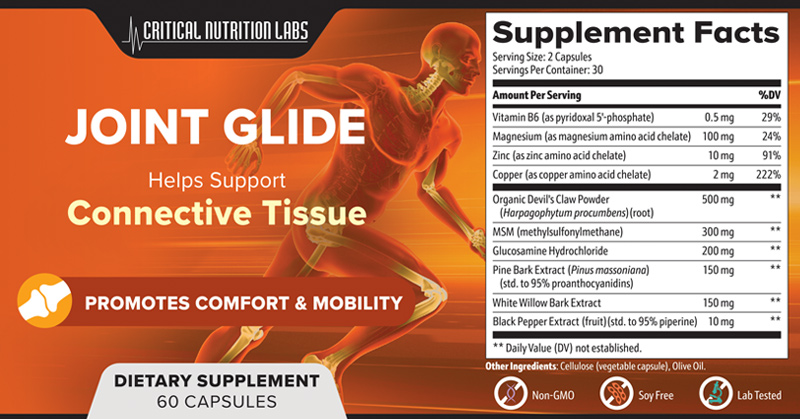
The facts show that every joint ingredient on the label is dosed below the amount used in its trials, and one, Pinus massoniana pine bark, has no joint research at all. This table sets the label dose against the research, checked October 27, 2026.
| Ingredient (label dose) | Benefit studied | What trials found | Trial dose |
|---|---|---|---|
| Devil's claw root powder (500 mg) | Knee and hip osteoarthritis pain | Pain eased as much as with diacerein over 4 months, no placebo arm[3] | 2,610 mg powder |
| MSM (300 mg) | Knee osteoarthritis function | Function improved vs placebo; pain change not significant (p=0.08)[5] | 3,375 mg |
| Glucosamine HCl (200 mg) | Knee osteoarthritis pain | No pain benefit vs placebo in 1,583 people[6] | 1,500 mg |
| White willow bark (150 mg extract) | Osteoarthritis pain | One 2-week trial helped; a 6-week trial did not[7][8] | 240 mg salicin |
| Pine bark, Pinus massoniana (150 mg) | No joint study found | Human data only on blood pressure[10] | 1,322 mg in that trial |
| Black pepper extract (10 mg) | Absorption of other compounds | Raised curcumin absorption in volunteers[11] | 20 mg |
Devil's claw is the strongest candidate
In a 122-person trial, cryoground devil's claw root eased knee and hip pain about as well as the drug diacerein, with less diarrhea (8.1% vs 26.7%)[3]. A systematic review rated evidence for powder delivering 60 mg harpagoside a day as moderate[4]. Joint Glide gives about one fifth of the trial powder dose and does not state its harpagoside content.
Glucosamine and MSM are token amounts
The NIH-funded GAIT trial gave glucosamine HCl 1,500 mg a day for 24 weeks; it did not beat placebo for pain[6]. Joint Glide's 200 mg is about 13% of that. MSM trials used 2 to 6 g a day[5]; 300 mg is 5% to 15% of those amounts.
Pine bark: trust the label, not the Pycnogenol stories
Some third-party pages describe the pine bark as Pycnogenol. The vendor label says Pinus massoniana[2], a different species, so the Pycnogenol knee studies do not apply.
The minerals and vitamin B6 play supporting roles
Magnesium 100 mg, zinc 10 mg, copper 2 mg and vitamin B6 0.5 mg round out the label. None has joint pain trials behind it in our research. The amounts sit under NIH upper limits: 350 mg a day for supplemental magnesium, 40 mg for zinc and 10 mg for copper[14]. Copper at 222% of the Daily Value is a common partner for zinc, since high zinc intake can lower copper status. See our full Joint Glide ingredients list for each one.
What about the rust enzyme story?
The sales letter builds its pitch on a "rust enzyme" that it says Joint Glide blocks, calling it "the only product that blocks this rust enzyme"[1]. That is the vendor's explanation. We found no study of Joint Glide measuring any enzyme, and the joint trials in the table above scored pain and function, not enzyme levels.
What should you check before buying?
Check whether the ingredients clash with your health or medicines, and set a fair test period. These points matter most.
- Blood thinners or daily aspirin: willow bark is a salicylate, and glucosamine has been tied to bleeding risk with warfarin[12]. Ask your doctor.
- Stomach ulcers or GI bleeding: devil's claw case reports include ulcers and bleeding[13], and willow bark adds a salicylate. Ask first.
- Aspirin allergy, under 18, pregnant or nursing: willow bark labelling says not for use[9].
- Shellfish allergy: the glucosamine source is not stated; ask the seller.
- Prescription drugs: piperine can raise blood levels of some medicines; show the label to your pharmacist.
- Timing: ingredient trials ran 2 to 16 weeks, so a few days tells you little. The refund window is 60 days, checked October 27, 2026.
See a doctor right away if a joint becomes hot, red or very swollen, if you have fever with joint pain, if a knee locks or gives way, or if you cannot bear weight. Our Joint Glide side effects page covers the safety side.
Our take
The honest list of Joint Glide benefits is short: possible mild help with joint pain, borrowed from ingredient trials that used larger doses than the label. Devil's claw carries most of that weight. Cartilage rebuilding, relief in days and avoiding surgery are vendor claims with no product study behind them. If you want to try it, clear the willow bark cautions with your doctor and judge it over several weeks. Our does Joint Glide work page grades the evidence, and the Joint Glide price page covers costs.
Back to the Joint Glide overview.
Frequently asked questions
Does Joint Glide rebuild cartilage?
That is a vendor claim. The sales letter promises to rebuild thick, strong cartilage in days, but no study of Joint Glide exists, and the ingredient trials we read measured pain and function scores over weeks, not cartilage regrowth in days.
How long does Joint Glide take to work?
The vendor says 3 to 7 days. The ingredient trials behind it ran 2 to 16 weeks, and most measured changes after several weeks. A fair personal test is several weeks, inside the 60-day refund window.
Which Joint Glide ingredient has the best evidence?
Devil's claw. A 122-person trial found its root powder eased knee and hip pain about as well as diacerein over 4 months, though there was no placebo group and the dose was 2,610 mg a day, about five times the label amount.
Is the glucosamine in Joint Glide enough?
Probably not by trial standards. Studies used 1,500 mg a day, and the NIH-funded GAIT trial found glucosamine HCl at that dose did not beat placebo for knee pain overall. Joint Glide has 200 mg, about 13% of that amount.
Can Joint Glide help me avoid knee surgery?
Avoiding surgery is the vendor's claim, not a tested result. Bone-on-bone knee pain needs a diagnosis and a doctor's plan, and no supplement study we found supports skipping surgical advice.
Sources
- Joint Glide sales letter. Critical Nutrition Labs, read October 27, 2026.
- Joint Glide Supplement Facts label image. Critical Nutrition Labs, read October 27, 2026.
- Harpagophytum procumbens for knee and hip osteoarthritis: four-month results of a double-blind trial versus diacerhein. Joint Bone Spine, 2000, read October 27, 2026.
- Harpagophytum procumbens for osteoarthritis and low back pain: a systematic review. BMC Complementary and Alternative Medicine, 2004, read October 27, 2026.
- Efficacy of methylsulfonylmethane supplementation on osteoarthritis of the knee: a randomized controlled study. BMC Complementary and Alternative Medicine, 2011, read October 27, 2026.
- Glucosamine, chondroitin sulfate, and the two in combination for painful knee osteoarthritis (GAIT). New England Journal of Medicine, 2006, read October 27, 2026.
- Efficacy and tolerability of a standardized willow bark extract in patients with osteoarthritis: randomized placebo-controlled, double blind clinical trial. Phytotherapy Research, 2001, read October 27, 2026.
- Efficacy and safety of willow bark extract in osteoarthritis and rheumatoid arthritis: results of 2 randomized double-blind controlled trials. Journal of Rheumatology, 2004, read October 27, 2026.
- USP safety review of willow bark. Planta Medica, 2019, read October 27, 2026.
- Pinus massoniana bark extract and blood pressure in older adults, secondary analysis of a randomized trial. PubMed, 2022, read October 27, 2026.
- Influence of piperine on the pharmacokinetics of curcumin in animals and human volunteers. Planta Medica, 1998, read October 27, 2026.
- Glucosamine and Chondroitin for Osteoarthritis: What You Need To Know (archived copy). NCCIH, read October 27, 2026.
- Devil's claw: gastrointestinal bleeding and ulcers. Prescrire International, 2013, read October 27, 2026.
- Copper: Fact Sheet for Health Professionals. NIH Office of Dietary Supplements, read October 27, 2026.
This page is general information, not medical advice. Dietary supplements are not reviewed by the FDA for safety or effectiveness before they are sold and are not intended to diagnose, treat, cure or prevent any disease. Talk to your doctor before taking any supplement, especially if you are pregnant, nursing, take medication or have a health condition.