TonicNest may earn a commission if you buy through links on this page, at no extra cost to you. That does not change what we report.
Part of our Joint Glide overview. Last checked October 27, 2026.
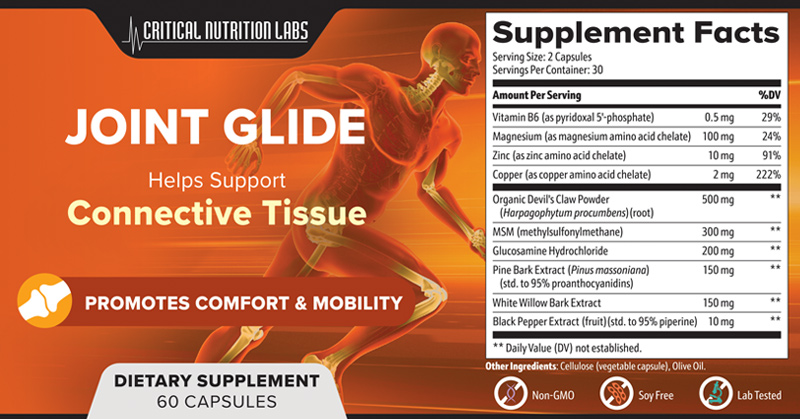
Joint Glide ingredients are 10 compounds in a daily serving of 2 capsules, led by organic devil's claw root powder 500 mg, MSM 300 mg, glucosamine HCl 200 mg, pine bark extract (Pinus massoniana) 150 mg and white willow bark extract 150 mg[1]. Every amount is printed, with no proprietary blend.
The catch is size. The 200 mg of glucosamine is about 13% of the 1,500 mg a day used in the NIH-funded GAIT trial[7].
Joint Glide ingredients at a glance
Five of the ten ingredients carry the joint story, and each one is either well below the amounts used in human trials or has no joint trials at all. The table lists the label amount next to our grade of the human evidence for joint pain, read on October 27, 2026. The grades describe the ingredient research, not Joint Glide itself.
| Ingredient (label) | Role the vendor gives it | Amount per 2 capsules | Evidence grade for joints |
|---|---|---|---|
| Organic devil's claw root powder | Pain relief, the "rust enzyme" | 500 mg | Limited; trial dose 2,610 mg |
| MSM (methylsulfonylmethane) | Joint comfort | 300 mg | Limited; trials used 2 to 6 g |
| Glucosamine hydrochloride | Cartilage support | 200 mg | Weak; trials used 1,500 mg |
| Pine bark extract (Pinus massoniana, 95% proanthocyanidins) | The "rust enzyme" | 150 mg | Weak; no human joint data for this species |
| White willow bark extract | "All natural aspirin" | 150 mg, salicin not stated | Limited; trials gave 120 to 240 mg salicin |
| Black pepper extract (95% piperine) | Absorption and pain | 10 mg | Absorption aid only |
| Magnesium (amino acid chelate) | Arthritis support | 100 mg (24% DV) | Weak |
| Zinc (amino acid chelate) | Listed mineral | 10 mg (91% DV) | No joint trials in our sources |
| Copper (amino acid chelate) | Listed mineral | 2 mg (222% DV) | No joint trials in our sources |
| Vitamin B6 (as P5P) | Listed vitamin | 0.5 mg (29% DV) | No joint trials in our sources |
What is in each Joint Glide ingredient, and what does research say?
Each of the main joint ingredients has some human research, but the trials used much larger amounts than Joint Glide supplies, and the pine bark species on the label has no joint trials at all. Here is each one in turn, with the studied dose next to the label dose.
Devil's claw root powder (500 mg)
Devil's claw (Harpagophytum procumbens) is a southern African root. In a 4-month trial of 122 people with knee and hip osteoarthritis, 2,610 mg a day of root powder eased pain about as well as the drug diacerein, with fewer side effects, but there was no placebo group[3]. A 2006 analysis of 14 trials called their methods generally poor[5]. Joint Glide's 500 mg is about one fifth of the trial dose, and the label does not state harpagoside, the compound researchers dose by[4].
Glucosamine HCl (200 mg)
Glucosamine hydrochloride at 1,500 mg a day did not reduce knee pain more than placebo in the 1,583-person GAIT trial[7]. A 2014 meta-analysis found that 13 trials of products other than one patented sulfate brand "consistently failed to show a reduction in pain"[8]. Joint Glide uses the hydrochloride form at 200 mg.
MSM (300 mg)
MSM is an organic sulfur compound. Small 12-week trials used 3.375 g to 6 g a day and found modest changes in knee function or pain[10][11]. Joint Glide's 300 mg is 5% to 15% of those amounts. A 2017 safety paper found MSM well tolerated by most people at up to 4 g a day[12].
Pine bark extract, Pinus massoniana (150 mg)
The label names Masson pine, not the French maritime pine (Pinus pinaster) sold as Pycnogenol. PubMed lists two human studies of Pinus massoniana, neither on joints; one gave 1,322 mg a day to 62 older adults for blood pressure[13]. Even for Pycnogenol, a Cochrane analysis found the evidence insufficient for any chronic condition[14].
White willow bark extract (150 mg)
Willow bark contains salicin, a relative of aspirin. Trials gave extracts with 120 to 240 mg of salicin a day: one small 2-week osteoarthritis trial was positive[15], while a 6-week trial of 127 people found no benefit over placebo, where diclofenac did help[16]. Joint Glide does not state its salicin content. As arithmetic only, a 25% salicin extract at 150 mg would give about 38 mg.
Black pepper extract (10 mg)
Piperine is used to raise absorption. At 20 mg a day for 7 days it raised blood levels of the drugs propranolol and theophylline in volunteers[18], which matters for anyone on prescription medicine.
Magnesium, zinc, copper and vitamin B6
These are ordinary nutrients at modest amounts. Copper at 2 mg is 222% of the Daily Value but under the NIH upper limit of 10 mg a day[19]; check any multivitamin you already take.
How transparent is the Joint Glide formula?
The Joint Glide formula is fully disclosed: all 10 ingredients carry an amount, and there is no proprietary blend hiding a total, which is rare for a ClickBank supplement[1]. The printed amounts add up to about 1,422 mg per serving, or roughly 711 mg per capsule, with minerals counted as their elemental amounts.
Three details are still missing from the label we read on October 27, 2026:
- the source of the glucosamine (it is often made from shellfish shells);
- the salicin content of the willow bark extract;
- the harpagoside content of the devil's claw, which is a plain powder, not a standardized extract.
Some third-party pages call the pine bark Pycnogenol. The vendor label says Pinus massoniana, so trust the label on the bottle in your hand over any copied list.
Ingredient safety and interactions
The willow bark is the ingredient to check first: it is an aspirin relative, and its USP safety monograph says it is not for children, pregnant or nursing women, or people with known aspirin sensitivity[17]. Devil's claw has case reports of stomach bleeding and ulcers[6]. NCCIH notes that glucosamine has been tied to a higher bleeding risk in people on warfarin[9]. Piperine can change how much of a prescription drug reaches your blood[18]. Our Joint Glide side effects guide lists the medicine groups to show a pharmacist and the symptoms that need a doctor.
Do these ingredients prove Joint Glide works?
No. The ingredient studies used different doses, different forms or a different pine species, and no study of Joint Glide itself exists. The sales letter still promises to "Rebuild Thick Strong Cartilage In Days" and to help people "Avoid Surgery"[2]; those are the vendor's words, and no trial of the product backs them. Knee pain that is severe or getting worse needs a diagnosis from a doctor. We weigh the claims one by one in does Joint Glide work, and the Joint Glide benefits page separates vendor promises from research. See how we check products for our method.
Back to the Joint Glide overview.
Frequently asked questions
Is the pine bark in Joint Glide the same as Pycnogenol?
No. The Joint Glide label lists pine bark extract from Pinus massoniana, standardized to 95% proanthocyanidins. Pycnogenol comes from a different tree, Pinus pinaster, and its knee trials do not transfer to Masson pine. Trust the label on the bottle over third-party ingredient lists.
How much glucosamine is in Joint Glide?
Joint Glide has 200 mg of glucosamine hydrochloride per 2-capsule serving. Most osteoarthritis trials, including the NIH-funded GAIT study, used 1,500 mg a day, so the label amount is about 13% of the studied dose.
Does Joint Glide contain shellfish?
The label does not say where its glucosamine comes from, and glucosamine is often made from shellfish shells. If you have a shellfish allergy, ask the seller, Critical Nutrition Labs, about the source before taking it, and check with your doctor.
Does Joint Glide use a proprietary blend?
No. The Supplement Facts panel gives an amount for all 10 ingredients, from vitamin B6 at 0.5 mg to devil's claw root powder at 500 mg. It does not state the salicin content of the willow bark or the harpagoside content of the devil's claw.
Why is black pepper extract in Joint Glide?
The 10 mg of black pepper extract supplies piperine, which is added to raise absorption. Piperine also raised blood levels of some prescription drugs in volunteer studies, so anyone on regular medicine should show the label to a pharmacist first.
Sources
- Joint Glide Supplement Facts label image. Critical Nutrition Labs (getjointglide.com), read October 27, 2026.
- Joint Glide sales letter. getjointglide.com, read October 27, 2026.
- Devil's claw root powder vs diacerein in knee and hip osteoarthritis, 4-month trial (Leblan 2000). PubMed, read October 27, 2026.
- Systematic analysis of Harpagophytum procumbens for osteoarthritis and low back pain (Gagnier 2004). PubMed, read October 27, 2026.
- Devil's claw for osteoarthritis, analysis of 14 trials (Brien 2006). PubMed, read October 27, 2026.
- Devil's claw: gastrointestinal bleeding and ulcer case reports (Prescrire 2013). PubMed, read October 27, 2026.
- Glucosamine/chondroitin Arthritis Intervention Trial (GAIT, Clegg 2006). PubMed, read October 27, 2026.
- Meta-analysis of glucosamine trials by product type (Eriksen 2014). PubMed, read October 27, 2026.
- Glucosamine and Chondroitin for Osteoarthritis: What You Need To Know. NCCIH, archived copy, read October 27, 2026.
- MSM in knee osteoarthritis, pilot randomized trial (Kim 2006). PubMed, read October 27, 2026.
- MSM in knee osteoarthritis, randomized trial (Debbi 2011). PubMed, read October 27, 2026.
- Methylsulfonylmethane: applications and safety (Butawan 2017). PubMed, read October 27, 2026.
- Pinus massoniana bark extract and blood pressure in older adults (Ferguson 2022). PubMed, read October 27, 2026.
- Pycnogenol for chronic disorders, Cochrane analysis (2012). PubMed, read October 27, 2026.
- Willow bark extract in osteoarthritis, 2-week randomized trial (Schmid 2001). PubMed, read October 27, 2026.
- Willow bark extract in osteoarthritis and rheumatoid arthritis, two randomized trials (Biegert 2004). PubMed, read October 27, 2026.
- USP safety evaluation of willow bark. PubMed, read October 27, 2026.
- Piperine and the absorption of propranolol and theophylline. PubMed, read October 27, 2026.
- Copper fact sheet for health professionals. NIH Office of Dietary Supplements, read October 27, 2026.
This page is general information, not medical advice. Dietary supplements are not reviewed by the FDA for safety or effectiveness before they are sold and are not intended to diagnose, treat, cure or prevent any disease. Talk to your doctor before taking any supplement, especially if you are pregnant, nursing, take medication or have a health condition.